
I still remember the goosebumps I got watching NASA’s tiny Ingenuity helicopter take its first tentative hop on Mars. It felt like watching the Wright Brothers all over again, but this time, millions of miles away. But as much as I loved that little tissue-box-sized marvel, what I am looking at today makes it look like a child’s toy. NASA has officially hit the “start” button on something straight out of a hard sci-fi novel: Dragonfly.
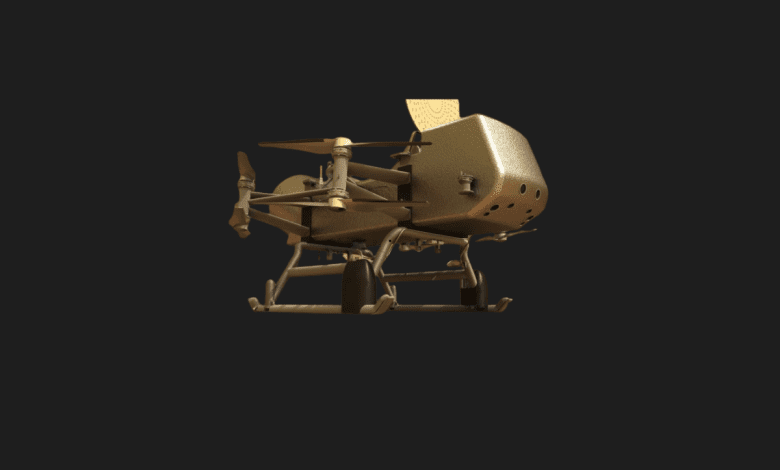
We aren’t talking about a fragile, solar-powered lightweight anymore. I’m talking about a car-sized, nuclear-powered, dual-quadcopter designed to soar through the alien skies of Saturn’s largest moon, Titan.
When I dug into the reports coming out of the assembly lines in Maryland this week, it blew my mind. We are no longer just dreaming about sending drones to explore the outer solar system; engineers are physically bolting the pieces together. Let’s dive into why this $3.35 billion beast is being built, how it works, and why I believe Titan might hold the ultimate answers to our origins.
From a Spark on Mars to a Behemoth on Titan

If you follow space exploration like I do, you know that flying on another celestial body is historically tough. Ingenuity proved it was possible on Mars, where the atmosphere is incredibly thin (just 1% of Earth’s). But Dragonfly is an entirely different beast built for an entirely different world.
Here is why Dragonfly is a massive leap forward:
- Size and Scale: While Ingenuity weighed a mere 1.8 kilograms, Dragonfly is roughly the size of an SUV. It is officially the second aircraft designed to fly on another celestial body, but the first of this immense scale.
- The Power Source: Solar power won’t cut it where Saturn lives; the sun is just a bright star in a dark sky. Dragonfly will be powered by a Multi-Mission Radioisotope Thermoelectric Generator (MMRTG)—basically, a nuclear battery that uses the natural decay of plutonium to generate electricity and keep the drone from freezing solid.
- A Flying Laboratory: Ingenuity was primarily a technology demonstrator—a proof of concept. Dragonfly is a fully equipped astrobiology lab. It’s carrying mass spectrometers, drills, and weather stations.
It’s not just a drone; it’s a rover that decided wheels were too boring.

Why Titan? The Solar System’s Ultimate Time Machine

You might be wondering, why go all the way to Saturn? Why not just send this to Mars or the Moon?
When I look at the data we have on Titan, I see a time machine. Titan is the only moon in our solar system with a dense atmosphere—in fact, its atmosphere is four times denser than Earth’s. It also has rivers, lakes, and seas. But here is the catch: they aren’t filled with water. They are filled with liquid methane and ethane.
Here is why scientists (and space geeks like me) are obsessed with Titan:
- Prebiotic Chemistry: Titan is rich in complex organic molecules. Its surface is literally coated in the chemical building blocks that could lead to life.
- A Glimpse of Early Earth: Many astrobiologists believe Titan’s current state looks incredibly similar to what Earth looked like billions of years ago, right before life emerged.
- An Aviator’s Dream: Because the gravity is low (about one-seventh of Earth’s) and the atmosphere is so thick, flying on Titan is actually easier than flying on Earth. If you strapped on a pair of wings and stood on Titan, you could literally fly by flapping your arms!
Dragonfly’s mission isn’t just to take pretty pictures. It’s going to hop from location to location, sampling the organic sand dunes and the bottoms of ancient, dried-up impact craters to look for the chemical signatures of life.
Inside the Assembly Line: Building the Beast

Reading about the actual construction of Dragonfly brings the reality of this mission home. Right now, at the Johns Hopkins Applied Physics Laboratory (APL) in Maryland, technicians aren’t just looking at blueprints anymore; they are turning screws and testing circuits.
The manufacturing process is a masterclass in extreme engineering. Here is what is happening right now:
- Testing the Brain: Engineers are actively testing the drone’s electronic modules and power-switching units. This is the “brain” of the spacecraft, ensuring it can autonomously navigate an alien world where real-time remote control is impossible due to the 80-minute light delay.
- Surviving the Deep Freeze: Titan’s surface temperature is a bone-chilling -179°C (-290°F). I was fascinated to learn about the specialized insulation foams and thermal management systems being installed. The nuclear battery doesn’t just power the rotors; its excess heat is funneled through the drone’s core to keep its delicate electronics from freezing.
- The Protective Shell: Before it can fly, it has to survive the brutal entry into Titan’s atmosphere. Teams are simultaneously working on the heavy-duty protective heat shield that will guard the drone during its fiery descent.
By early 2027, the initial assembly and module testing will wrap up. After that, this massive piece of hardware will be shipped to Colorado for intense environmental system testing—basically throwing it into thermal vacuum chambers to simulate the worst conditions space has to offer.
The Launch and the Long Journey Ahead

Patience is a virtue in space exploration, and I have to constantly remind myself of that.
Even though the assembly has started now, the launch is scheduled for the spring of 2028. NASA has chosen the mighty SpaceX Falcon Heavy rocket to blast Dragonfly off our planet.
But it’s a long road to Saturn. Dragonfly will spend years cruising through the dark, cold vacuum of deep space, performing gravity assists to build up speed, before finally arriving at Titan in the mid-2030s.
When it gets there, it won’t just land and stay put. Dragonfly will perform a series of “hops,” flying dozens of miles at a time. It will cover more distance on its first few flights than any Mars rover has covered in a decade. It will drill into the alien soil, suck up samples, run them through its onboard chemical lab, and beam the data back to Earth.
My Take: Are We Ready for What We Might Find?
Whenever I write about missions like this, I try to take a step back and look at the bigger picture. We are taking a nuclear reactor, strapping eight helicopter blades to it, and throwing it at a moon a billion miles away to see if we can find out how life started.
If you ask me, Dragonfly is the most ambitious and daring robotic mission NASA has ever attempted. It carries the very real possibility of discovering that the chemical steps leading to life are common in the universe. If we find complex prebiotic chemistry—or even signs of actual biology—hidden in the frozen methane dunes of Titan, it will fundamentally rewrite our understanding of our place in the cosmos.
It makes you realize that we are living in a golden age of exploration. We aren’t just looking at dots of light through telescopes anymore; we are building flying machines to go touch them.
I’d love to hear your thoughts on this: If Dragonfly actually discovers that the chemical precursors for life exist on Titan, how do you think that will change humanity’s perspective on the universe? And honestly, if you had the chance, would you want to pilot a drone through a methane rainstorm on an alien moon? Drop your thoughts below!
You Might Also Like;